Why a Spoon’s Bowl Changes with Its Job
Why a spoon’s bowl changes with its job: see how bowl depth, width and handle shape affect scooping, sipping and serving different foods.
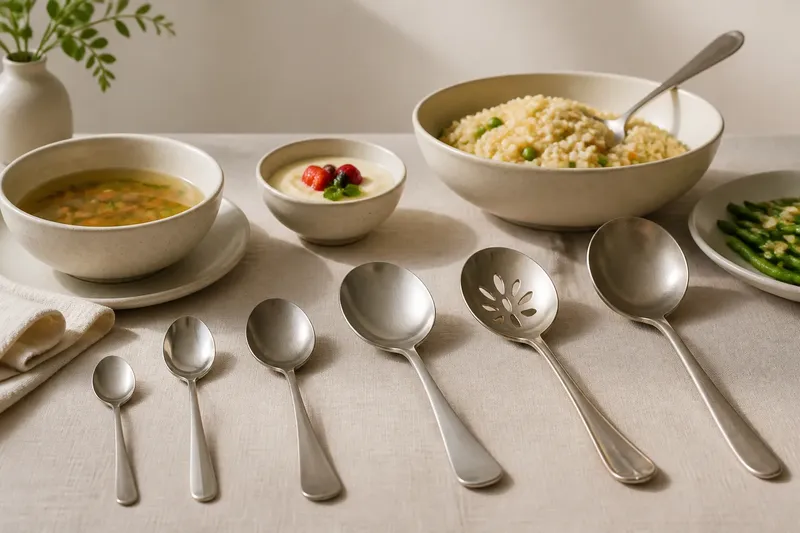
The common mistake with spoons is treating every bowl as a smaller or larger version of the same shape. That can leave a thin broth sloshing from a shallow spoon or a dense mouthful awkwardly wedged in a deep one. Why a spoon’s bowl changes with its job comes down to how it meets food, carries it and lets a person bring it to the mouth or serving dish.
Look at a soup spoon beside a teaspoon and a serving spoon. Their differences are not merely a matter of size. Bowl depth controls how much liquid sits below the rim; width affects how much food can be gathered in one pass; and the handle helps the user guide, lift or reach with the loaded bowl. These features work together, but each answers a different practical problem.
How does bowl depth affect what a spoon carries?
A deeper bowl holds liquid below its rim, so it can carry broth or sauce while the hand moves. A shallow bowl exposes more of the food to movement and lets the user take a thinner mouthful. The useful depth depends on whether the food needs containing, spreading or portioning.
For a clear soup, a rounded, fairly deep bowl can gather liquid with a small amount of solid food. For porridge or soft rice, a medium-depth bowl may be easier to fill and eat from without making each mouthful feel crowded. A shallow spoon suits foods that are already spread out, such as a soft dessert, or tasks where the spoon is used to smooth or portion rather than transport a runny liquid.
Depth also changes how easily someone can scrape the bowl clean. A steep inner wall can keep sauce together, but the curve may make the last portion harder to reach with the edge of a plate. A shallower transition from bowl to rim can make scraping simpler. The shape is a compromise between holding food securely and releasing it where it is wanted.
Why are some spoon bowls wide and others narrow?
A wider bowl gathers more food across a broad surface. That helps with serving soft vegetables, mashed food or a generous portion of rice, where a narrow scoop might need several passes. A narrow bowl can slip between pieces in a jar or dish, and it is easier to guide a small mouthful without spreading it across the lips.
Width matters especially when food is mixed. A broad spoon can carry a combination of sauce and solid pieces together, while a narrower one gives the user more control over selecting one ingredient. The curved sides help determine whether the spoon gathers food towards its centre or lets it slide off easily.
Imagine a household serving thick lentil stew from a deep pot. A broad, moderately deep serving spoon could collect lentils and liquid in one scoop, while a narrow teaspoon would take longer and tend to pick up less of the mixture at once. The observable difference is not that one shape is universally better; it is that the serving spoon matches the size of the dish and the texture being moved.
What does the handle shape change?
The handle gives the hand leverage and determines how the bowl sits in relation to the wrist. A short handle keeps the user close to a small cup or dish. A longer handle helps reach into a pot, tall glass or serving bowl without placing fingers near the food. The distance also changes how much the hand’s small movements affect the bowl.
A straight handle is easy to hold in several orientations and can be passed between users without requiring a particular grip. A curved or angled handle can set the bowl at a useful angle for a specific task, though it may feel less natural to someone holding it differently. A broad, flat handle can rest against the fingers; a thin round one may rotate more readily in the hand.
Weight and balance matter too. If the handle is heavy compared with the bowl, the spoon may tip when set down or feel tiring when held out at arm’s length. If the bowl carries most of the weight, a small loaded spoon may feel less controlled. For everyday use, the best clue is whether the spoon stays stable during the movements the task requires.
Which spoon shape suits soup, dessert and serving?
For soup, look for a bowl with enough depth to retain liquid and a rim that allows a comfortable sip. A broad oval bowl may carry a substantial mouthful; a smaller rounded one offers more measured sips. Very shallow bowls are usually less suited to moving thin soup across a table, while an extremely deep bowl can make sipping feel cumbersome.
For dessert, the food’s texture guides the choice. A narrow teaspoon works well for small portions and confined containers. A wider dessert spoon is useful for custard, mousse or soft fruit, where the bowl can gather a balanced bite. Firm pieces may call for a sturdier edge that can separate a portion without bending or skidding.
For serving, size and reach take priority over mouthful shape. A long-handled spoon helps reach into a deep serving bowl; a broad bowl can lift soft portions without breaking them apart. A slotted spoon is different again: openings let liquid drain while leaving solid food in the bowl. It is useful when the job is to transfer food but not its cooking liquid.
How can you choose a spoon for a particular food?
Start with the food’s consistency and the route it must travel. Ask whether the spoon needs to hold liquid, gather loose pieces, cut through a soft portion, reach down into a container or deliver a small bite. Then compare the bowl and handle against that task rather than choosing by appearance alone.
- Thin liquids: favour a bowl with enough depth to contain a sip during movement.
- Thick mixtures: consider a broader bowl that can gather solids and sauce together.
- Small containers: choose a narrow bowl and handle that can reach without scraping the rim constantly.
- Deep pots: look for a longer handle that keeps the hand away from the contents.
- Soft portions: favour a broad, supportive bowl that lifts food without squeezing it out at the sides.
- Draining cooked food: use a slotted design when liquid should run back into the pot.
These are starting points, not strict rules. A spoon used by a child, someone with limited grip or a person eating from a particular kind of dish may need a different handle or bowl. Comfort and control can matter more than matching a traditional category name.
What should you notice when a spoon feels awkward?
Notice where the difficulty begins. If liquid spills during the lift, the bowl may be too shallow or the spoon may be tilted too far. If food is hard to gather, the bowl may be too narrow for the dish or the sides may be too flat. If the mouthful feels unwieldy, a smaller or narrower bowl may offer better control.
Try the spoon with the food and vessel it is meant to serve. A spoon that works in a wide bowl may be clumsy in a narrow mug; a short handle comfortable at the table may be inconvenient in a deep pot. If you are choosing a specialist spoon, check its intended use and any care guidance on the label or from the maker.
Do all spoons need a specialised shape?
No. A general-purpose spoon can handle many ordinary foods, and owning a separate utensil for every texture is not worth the cupboard space. A few distinct shapes make sense when a task repeatedly exposes a limitation: a deep bowl for sipping broth, a serving spoon for a large dish, or a slotted spoon for lifting solids from liquid.
Names such as soup spoon, dessert spoon and serving spoon are useful clues, but they do not describe every variation. Compare the actual bowl depth, width and handle length. A label tells you what a maker intended; the spoon’s shape tells you what it can comfortably do.
Why does a spoon’s bowl change with its job?
Because foods and vessels ask for different kinds of control. Depth helps retain liquid, width determines how much can be gathered, and the handle sets reach and leverage. When choosing a spoon, match those features to the food’s texture and the movement it must make; that is the simplest way to see why a spoon’s bowl changes with its job.
One small observation can sharpen the choice: watch what happens to the food as the spoon leaves the dish. If it drips, spills, crumbles or refuses to slide off, the mismatch is often visible in the shape. The next spoon you pick up may then feel less like a generic utensil and more like a tool made for that particular mouthful.