How Buttons Became Part of a Garment’s Closure
See how to tell a decorative button from a working fastener by reading its buttonholes, stitching and place on the garment, without guessing from shine alone.
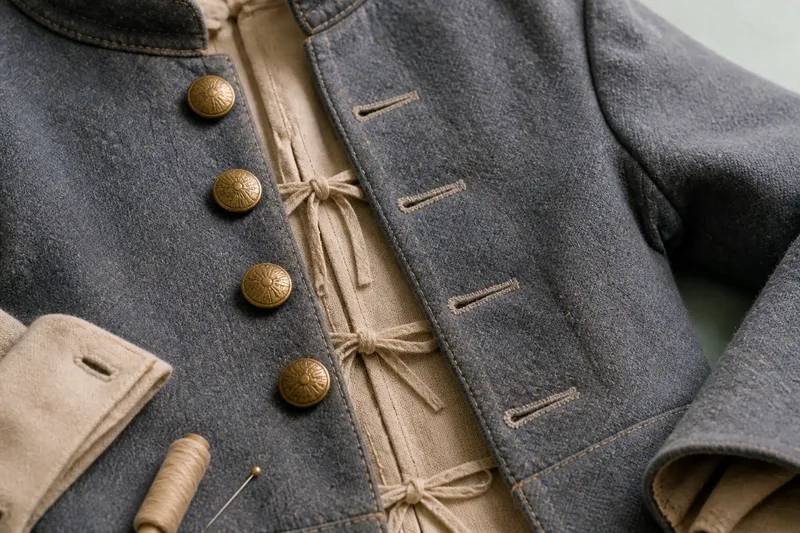
The common mistake when reading old clothing is to assume every button was made to fasten. A button without a matching opening may be decoration, but the garment’s stitching and construction offer better clues than appearance alone.
Read the garment before assigning a button a job
A button is attached to cloth by holes through its face or by a shank at the back. To fasten, it needs a corresponding opening that is finished to resist fraying. Some garments also use ties, pins or overlapping panels, so a button sewn to the surface may be ornamental rather than functional.
That distinction does not establish a universal chronology. Button forms and garment closures varied across places and periods, and a surviving object may have been altered or repaired. Without a documented garment and context, it is safer to describe what the visible construction supports than to claim that buttons generally preceded buttonholes.
Look at the whole opening. A row of buttons aligned with reinforced slits suggests a working closure. Buttons with no corresponding openings, especially when sewn onto a stable surface, may have been added for display. Neither clue is conclusive on its own: repairs, missing pieces and later changes can obscure the original arrangement.
Exchange is visible in choices, not just in objects
A button crossing a border does not carry a complete set of instructions for how to wear it. Its use depends on local garment cuts, materials, sewing skills and preferences. A maker might copy its shape, use a different material, place it as trim or adapt a garment to make it functional. These are possibilities to investigate in a specific case, not a single history that applies everywhere.
When a collection record names a place and period, compare the button with the garment’s opening, attachment and surrounding construction. A museum catalogue or conservation note may clarify whether an item is original, replaced or part of a later alteration. If that context is absent, mark the interpretation as uncertain rather than filling the gap with a story about trade.
Say you are examining an invented wool jacket with four brass-coloured buttons down the front. You find four finished slits opposite them, and the fabric around each slit is reinforced; the likely reading is that the buttons served as a closure, though the material alone does not establish where they were made. If the same invented jacket instead has no slits and the front is held by ties beneath the button row, the buttons are more likely decorative. In either case, a catalogue describing the jacket’s documented place and date would be needed before making a cross-border claim.
Check these details before deciding what a button did
- Check whether a finished opening sits opposite the button; if it does and aligns naturally, treat fastening as plausible, but if it does not, look for another closure or consider decoration.
- Check whether the opening edges are reinforced; if they are, that supports repeated fastening, but if they are raw or damaged, consider wear, loss or later alteration before deciding.
- Check how the button is attached; if its shank or sewing holes bear against the cloth in line with the opening, consider it functional, but if it sits flat on an uninterrupted surface, consider ornament.
- Check for ties, pins or overlapping panels beneath the button row; if they secure the garment, treat the buttons as possibly decorative, but if they do not, inspect for a missing or altered fastening.
- Check whether the cloth around the button or slit is strained or patched; if it shows wear consistent with pulling, consider regular use, but if the area is undisturbed, avoid inferring frequent fastening.
- Check the catalogue or conservation record for repairs and replacements; if it identifies later work, separate those additions from the original construction, but if no record exists, state that the button’s history remains uncertain.
Which clues answer common questions about buttons?
How can you tell whether a button was meant to fasten?
Look for a matching, finished opening and check whether the button’s position and attachment align with it. If the garment has been altered or the opening is missing, describe the evidence as uncertain.
Why might a garment have more buttons than it needs?
Some may be decorative, placed to create a visual rhythm or balance. A button count alone does not show how the garment was worn.
Can a button’s material reveal where it came from?
Material can suggest what a maker chose to work with, but it cannot identify an origin by itself. Look for a documented record and consider the garment’s construction alongside the button.
What should you do if the garment and button seem inconsistent?
Consider repairs, replacement buttons or a change in how the garment was used. Record the mismatch and seek a collection or conservation note before making a firm claim.
What is not worth the effort
It is not useful to assign a single origin story to every button or infer a route of exchange from shine, shape or material alone. Those details can prompt questions, but they rarely settle where an object was made or how it travelled.
For a search about buttons and buttonholes, the most reliable answer starts with the garment: compare the button’s position with its opening, seams and other closure methods. That careful reading can distinguish likely function from decoration while leaving room for the evidence that is not there.