A Basket Is Not Just a Container
Choose a basket by shape and weave to keep its contents settled, visible and easy to reach, whether it sits on a shelf or travels between rooms.
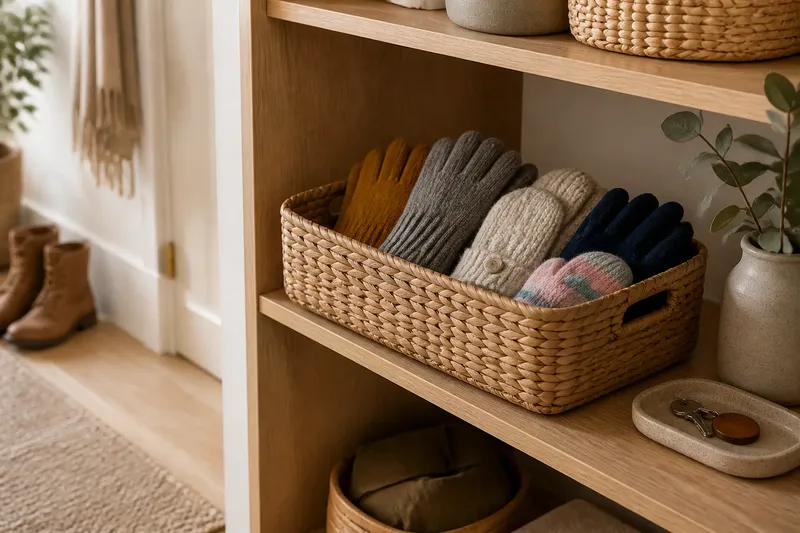
The most common basket mistake is choosing by appearance alone. A wide, open basket may look handy by the door, but small objects can slip through its weave and a shallow rim may not contain a shifting pile. Basket shape and weave matter because they change how objects settle, how easily you can reach them and how the basket fits into daily routines.
Start with the way a basket will be used
A basket takes part in a small routine. Someone lifts it from a shelf, drops in a handful of gloves, carries it across a room or leaves its contents on display. Those actions give you a better way to judge a basket than appearance alone: notice how objects enter, where they rest and how they come out again.
A low basket leaves its contents in view and makes sorting easy, but it needs room on a surface. A deep basket can tuck beside furniture and gather taller things, though small objects may vanish at the bottom. Handles alter the experience too: a firm side grip may make a full basket easier to lift from a shelf, while a high handle can be useful for carrying a gathered load.
Think about the people who share the basket. A child may need a rim low enough to reach across; a basket used by several people may need contents to be obvious at a glance. In a busy household, a plain, visible place for gloves can be more useful than a beautiful container that is hard to use without rearranging other things.
Read the basket through its material and making
Weaving is not merely decoration. The spacing between strands affects what can pass through, what can catch and how much of the contents remain visible. A close weave tends to contain small, loose objects. An open weave makes contents easier to see and allows air to pass, but thin items can snag or slip through.
Material and finish shape the relationship between basket and contents. Rigid strands preserve the basket’s outline when it is empty. Softer materials may give a little as objects are placed inside. Rough ends can catch a knitted scarf or delicate fabric; a smooth lining may help, but it can also hide the weave or complicate cleaning.
There is no single traditional form that means the same thing everywhere. Materials, weaving methods and uses vary among makers and communities. A basket may be made for carrying, storing, displaying or marking a particular practice; its shape alone cannot tell you its full history. If that context matters, look for information from the maker or seller rather than guessing from a pattern.
For food storage, do not assume that every woven basket is suitable for direct contact. Check the maker’s care guidance and any relevant local food-safety advice. A basket used to display wrapped packets has different demands from one that holds unwrapped produce.
Use these observations to make a choice
Before selecting a basket, inspect the space and the contents together. Each observation points towards a decision, and each can also rule out a tempting but awkward option.
- Small objects: Check whether the gaps are wider than the objects. If they are, choose a closer weave or a fitted liner; otherwise, the open weave may be suitable.
- Delicate fabric: Run your fingers gently over the interior strands. If rough ends catch, choose a smoother basket or use a well-fitting liner; if the surface feels even, it may be ready for scarves or cloth.
- Frequent access: Check whether you can see and reach the contents from where the basket will sit. If not, choose a lower profile or a wider opening; if access is clear, the deeper shape may be convenient.
- Shelf storage: Check the basket’s widest point, including handles, against the shelf opening. If it catches or leaves no room to grip, choose a narrower form; if it slides in and out comfortably, it fits the space.
- Carrying: Hold the empty basket by its handles and look at how its base sits. If the grip twists or the base tips easily, choose a steadier form; if it stays level, consider it for a gathered load.
- Air and visibility: Check whether you need to see the contents or let air pass through. If you do, favour an open weave; if small pieces need containing or contents should be less exposed, choose a closer weave.
Say you have an invented, hypothetical situation: a family wants one basket for gloves beside a narrow hallway shelf. The shelf opening is narrower than the basket’s handles, and the gloves include small children’s mittens. First, they rule out the basket with handles that catch on the shelf. Next, they compare the gaps in two alternatives with the mittens: one has openings large enough for a mitten thumb to slip through, while the other has a close weave. They choose the close-weave basket with a lower rim, then place it on the shelf and check that a hand can reach the gloves without pulling the basket out. The result is a choice that contains the small mittens and remains accessible; the trade-off is less visibility through the weave.
Some basket features are not worth the effort
A liner, label or matching set is useful only if it solves a real problem. A liner may protect delicate fabric, but it is not worth adding if it blocks the ventilation you need or makes cleaning awkward. Labels can help in a shared cupboard, but they add little to a basket whose contents are already obvious. Choose the simplest arrangement that supports the routine.
What should you check before choosing a basket?
Does basket shape matter more than size?
Shape and size work together, but shape determines how the available space behaves. A roomy basket can still be awkward if its opening is narrow, its base unstable or its sides make the contents hard to reach.
Is a close or open weave better?
A close weave is suited to small, loose contents that need containing. An open weave favours visibility and airflow, provided the gaps will not snag or release what you put inside.
Should a basket have a liner?
A liner can shield delicate items from rough strands or help contain small pieces. It can also make cleaning and airflow harder, so let the contents and care needs decide.
How can you tell if a basket will fit a shelf?
Check its widest point, including handles, against the shelf opening, then consider whether you can grip it in place. A tapered body may fit while still leaving less usable room for contents than its rim suggests.
Choose a basket that suits its place
Basket shape and weave make the most sense when read alongside the objects and habits around them. Notice what needs to stay contained, what should remain visible and how the basket will be lifted or reached. Those details help distinguish a useful form from one that merely looks right.
When a basket comes from a particular making tradition, its use may carry meaning beyond storage. Ask about its maker and context when that information is available. The basket then becomes easier to understand as both a practical object and part of the place and people from which it comes.